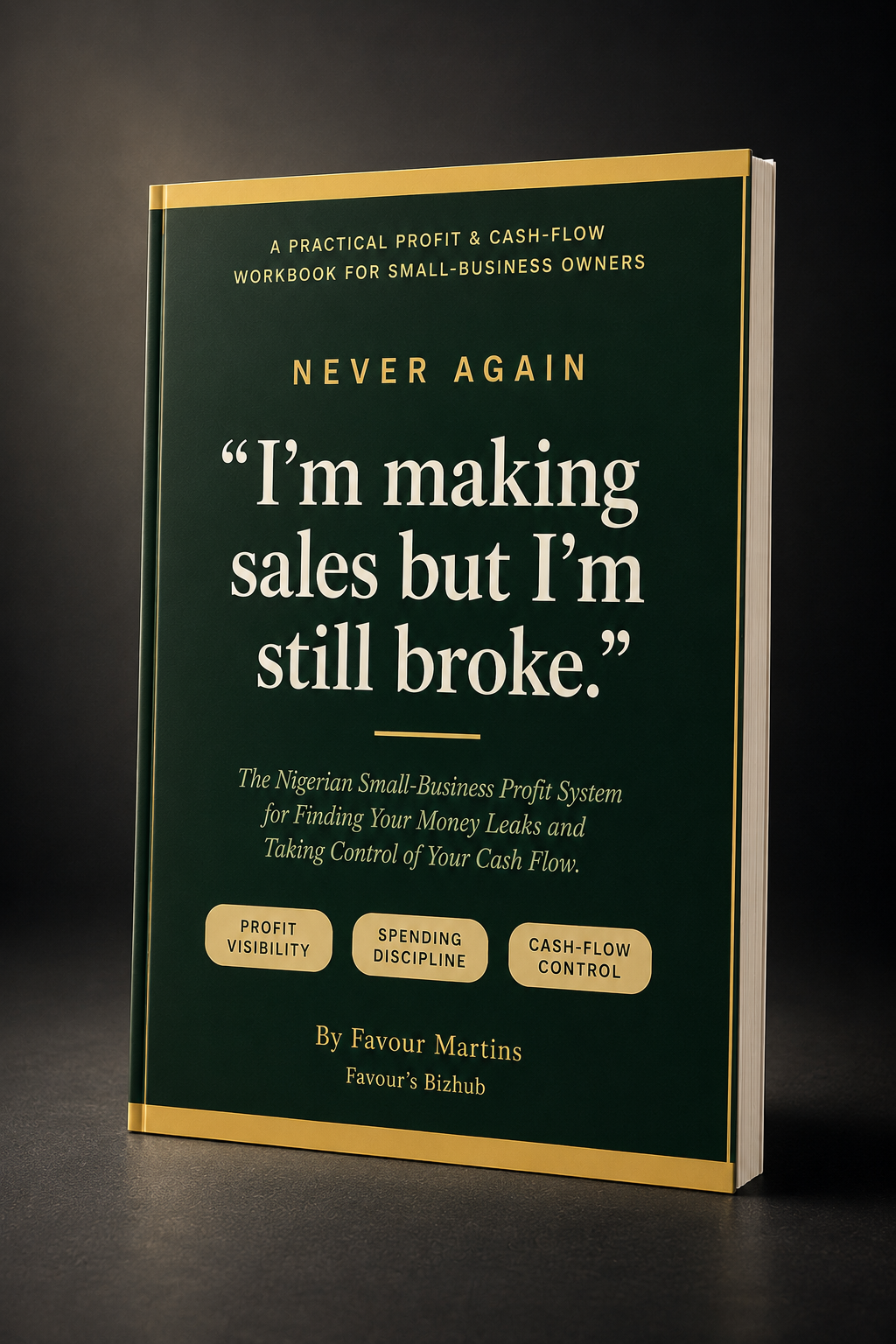
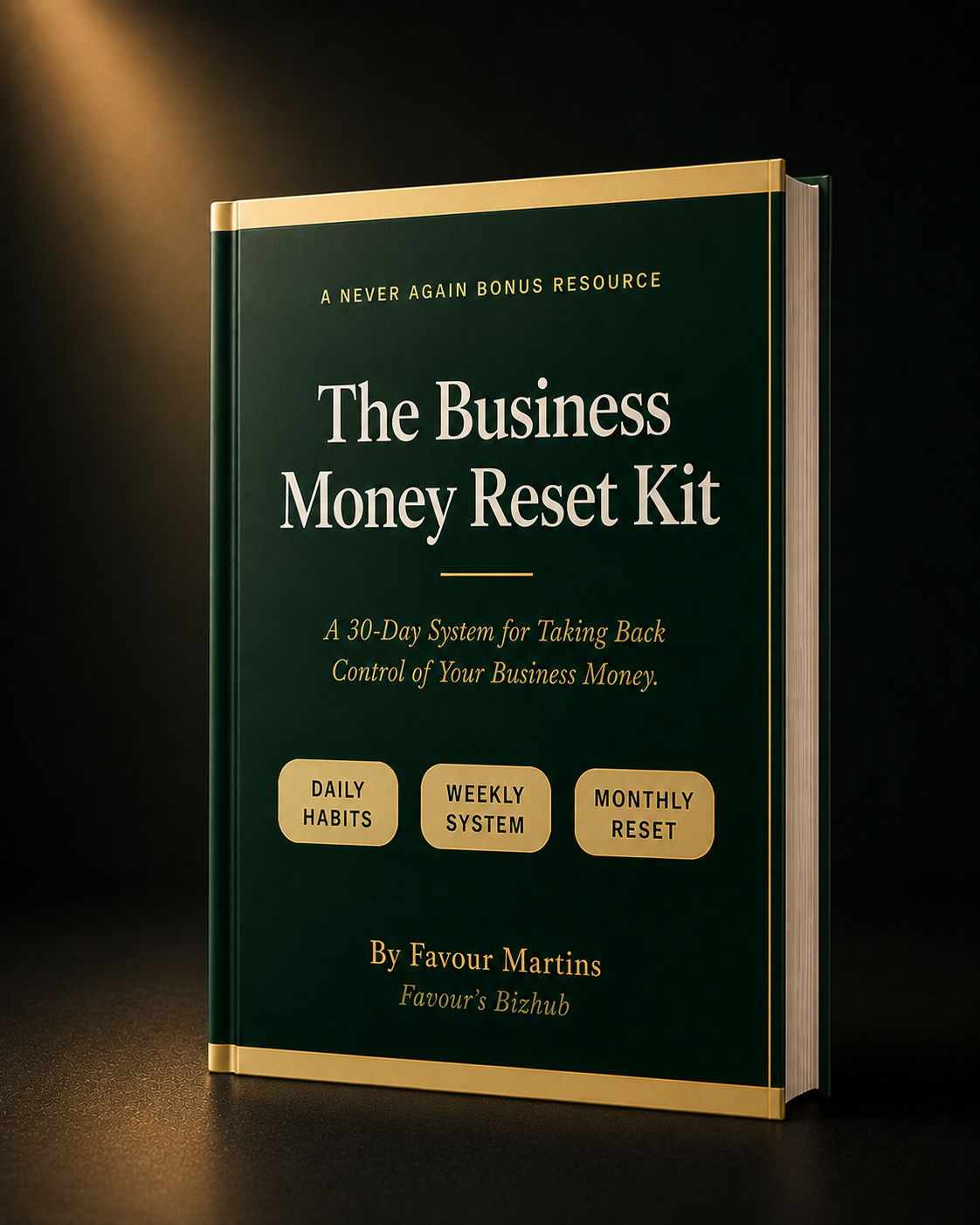
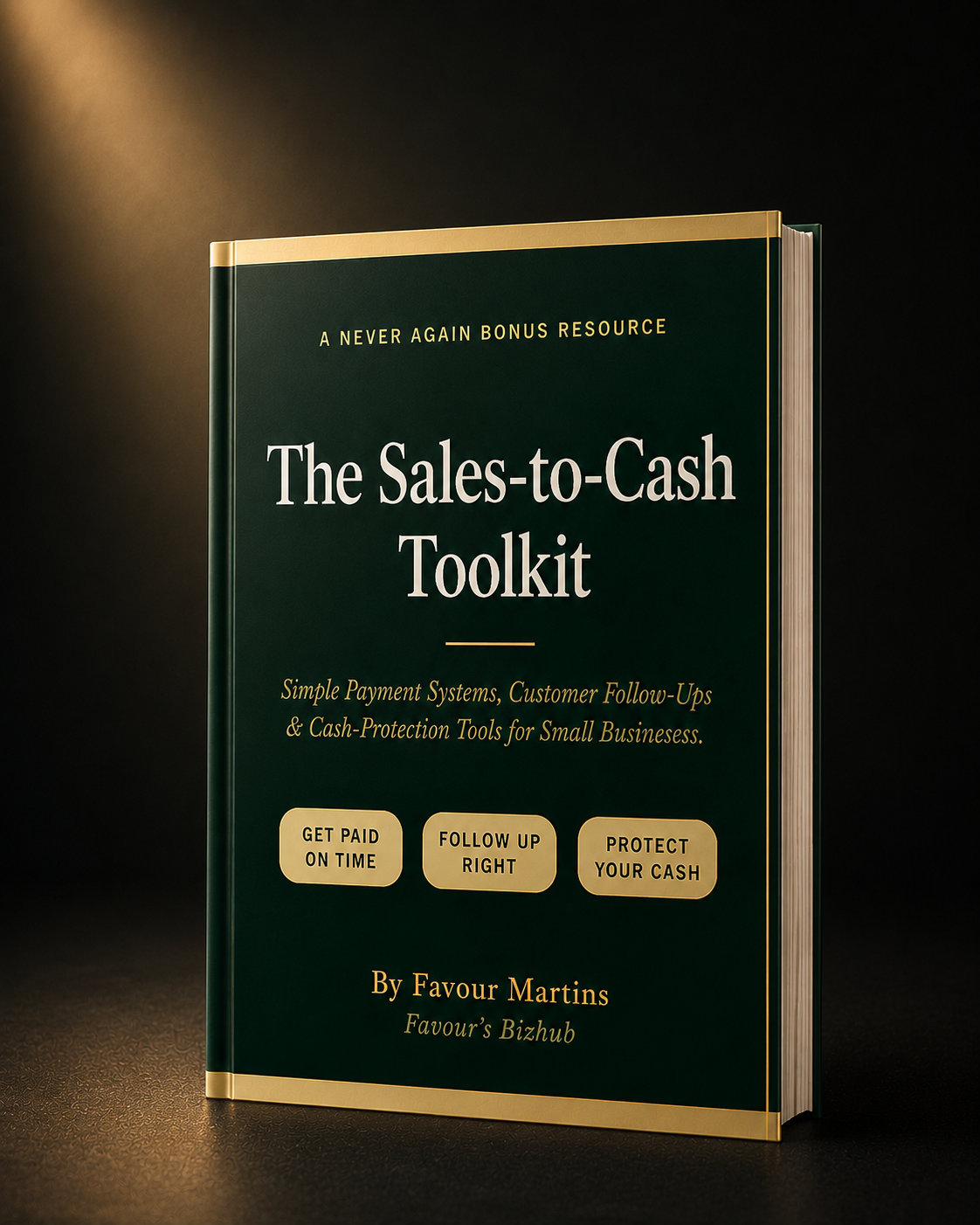
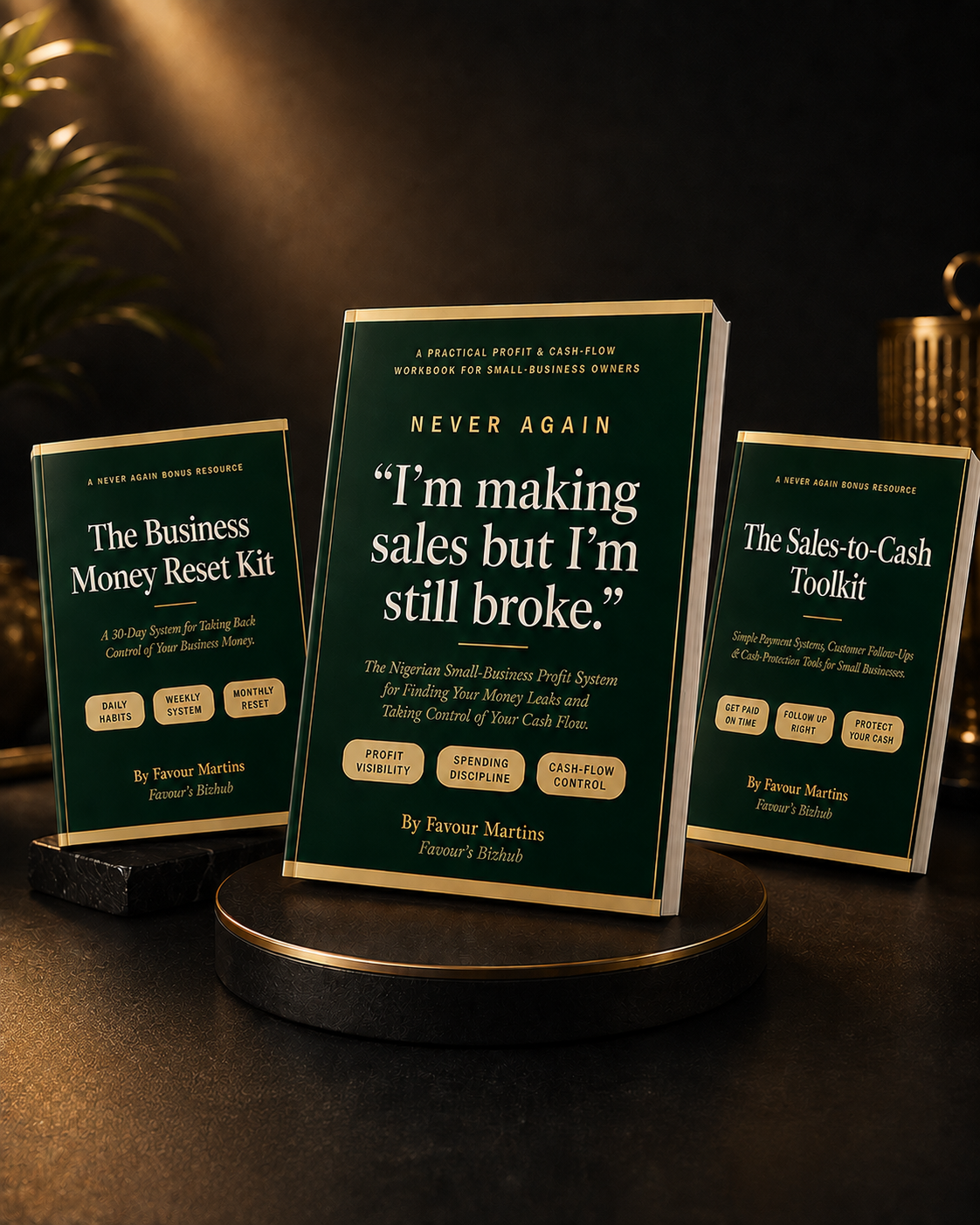
NEVER AGAIN — "I'm Making Sales But I'm Still Broke"
A Practical Profit & Cash-Flow Workbook For Small-Business Owners

You Check Your Account Balance With Your Eyes Half-Closed — And You Can't Explain Why Anymore.

The alerts come in all day. Orders confirmed. Customers paid. Another sale, another “thank you ma,” another delivery arranged.

By the time you close for the day, you've worked harder than almost anyone you know.

And then you check your account. And it's just… not there. Not the way it should be, not the way it feels like it should be, after a day like that.

So you tell yourself you'll sit down and “sort out the books” this weekend. You don't. Not because you're lazy — because some part of you is scared of what you'll find. Or worse, scared of finding nothing at all.

If that's you, I need you to hear this clearly: this is not a hustle problem. You are not lazy, and you are not bad with money. You have a visibility problem — and it has a fix.

GET IT NOW FOR ₦14,500 Launch price — for immediate action. Scroll down to see everything inside.
Here's What Nobody Told You

Sales and profit are not the same word — even though they feel like they should be.

Every naira that touches your hand from a sale has to survive four separate questions before it's actually yours: What did it cost to make? What did it cost to run the business that made it? What's left after both? And — this is the one that breaks people — how much of that “leftover” is actually sitting in your account right now, versus tied up in stock, or owed to you by a customer who hasn't paid yet?

Most business owners only ever track the first number — the sale. Nobody ever sits them down and shows them the other three. So the business can be genuinely, provably profitable on paper, and still feel completely broke in real life — because profit and cash-in-hand are two different things, and no one taught you to watch both.

You're not leaking money because you're careless. You're leaking money because you were never shown where to look.

The Story Behind Never Again

My husband runs a men's fashion business. For a long time, we thought our biggest problem was getting customers.

We were wrong.

Customers were coming. Sales were happening. Some days we'd have several different items moving at once, and from the outside, it looked like the business was doing very well.

But there was one question we couldn't answer: after all those sales, where was the money?

We could have a genuinely good sales day, and then look at the account afterward and quietly wonder how the money had already disappeared. It wasn't that the business wasn't making money. The real problem was that we weren't keeping proper records. Sales income, business expenses, and personal spending all lived in the same blurry pile, moving in and out of the same account, with nothing separating one from the other.

So even on our best days, we couldn't answer simple questions: How much did we actually make? What did we spend, and on what? What was left after expenses? Which part of the business was quietly eating the most money? Was the business even growing financially, or just staying busy?

That was the wake-up call. Making sales and making money are not the same thing. You can have customers. You can have products moving. You can have money entering your account every single day — and still not understand your own finances, because you don't have a system for tracking any of it.

That's when we said it to each other: never again.

Never again would we run the business on guesswork. Never again would we make sales without being able to say, clearly, where that money went. Never again would we mix business income with expenses and just hope it balanced out at the end of the month.

So we changed how we operated. Instead of relying on memory, or just glancing at the bank balance and assuming that told the whole story, we started using a workbook to properly track income, expenses, and cash flow. Every inflow had a place to be written down. Every expense had a place to be written down. For the first time, we could look back and actually see what was happening in the business — not guess at it.

That gave us something we hadn't had before: clarity. We understood our sales instead of just celebrating them. We knew what came in, what went out, and what was genuinely left. We stopped treating every naira that entered the account as money that was simply “available,” and started making more intentional decisions with it.

That experience taught me something I now believe completely: it is not enough to make sales — you have to be able to account for them. A business owner shouldn't finish a busy, successful month and still be left asking, “where did it all go?”

That's the reason NEVER AGAIN exists. It was born from a real, lived lesson: sometimes the problem isn't that your business isn't making money. Sometimes the problem is that you have no system to see, track, and manage the money it's already making.

This workbook is about bringing structure to that mess. Separating income from expenses. Understanding cash flow. Keeping real records. Getting to the point where you can look at your business and say, honestly: I know what's coming in. I know what's going out. And I know exactly where my money is going.

Because from now on — never again. — Favour Martins, Favour's Bizhub
What Actually Happens When You Start

One short, focused task a day.

Day 1

You do a full, honest Financial Reality Check: what's really in the account, what's owed to you, what you owe. No judgment, just facts on paper — maybe for the first time ever.

Day 3

You find your #1 profit leak — the specific one costing you the most, out of the 10 most common ones small business owners carry.

Day 4

You reprice your top products using one simple formula, and finally know what they should actually cost.

Day 5

You separate business money from personal money, even if it's just a written system to start with.

Day 7

You walk away with a written 30-day plan — not a vague intention, an actual plan with dates and goals.

Day 30

Your guarantee window (see below). You've run at least one full Weekly Money Meeting, filled real numbers into your tracker, and — most importantly — you know things about your own business you didn't know a month ago.